

Summer is here — and so is the sneaky threat every parent and teacher knows well: the summer slide. That’s the learning loss that happens when kids go weeks without practicing reading and math. By the time September rolls around, many students return to school behind where they left off.
The good news? You don’t need worksheets or tutoring sessions to fight it. Games are one of the most powerful — and fun — tools for keeping young minds sharp all summer long.

What Is the Summer Slide?
The summer slide is the learning loss that occurs when students are out of school for extended periods without academic practice. For K–3 students, reading and math are the two skills most at risk. Kids can lose weeks of hard-earned progress simply from lack of regular practice — and it compounds year after year if left unchecked.
The great news? Summer slide prevention doesn’t have to feel like school. With the right games, kids stay sharp without even realizing they’re learning.
Why Are Games So Effective for Summer Learning?
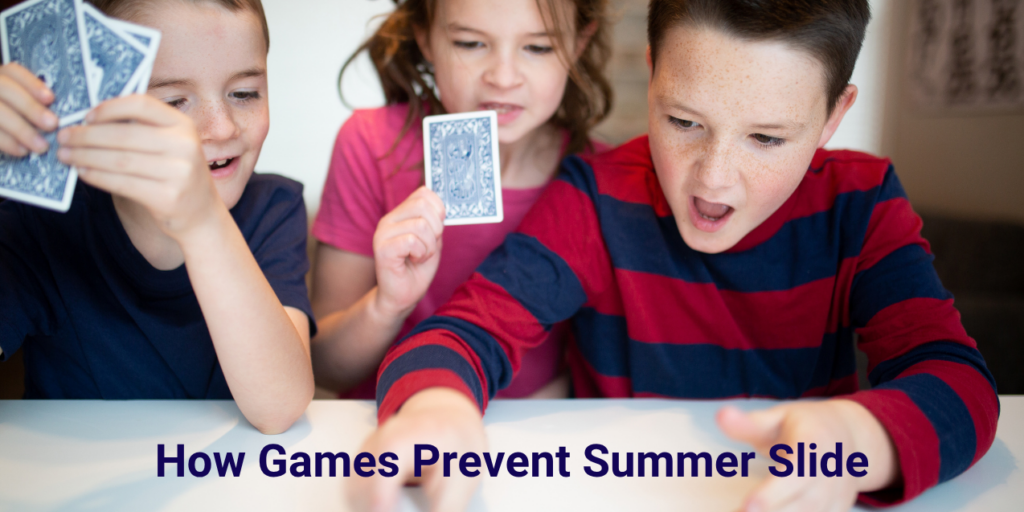
Here’s the secret: kids don’t resist games the way they resist homework. A child who won’t sit still for a math worksheet will spend 45 minutes intensely focused on a card game that uses the exact same skills.
Games naturally build in:
- Repetition without boredom
- Immediate feedback and rewards
- Problem-solving and critical thinking
- Social skills like turn-taking and communication
For parents and teachers, game-based learning is one of the most practical, low-effort strategies available — and kids genuinely look forward to it.
What Are the Best Games to Prevent Summer Learning Loss?
Board Games for Elementary Students
Don’t underestimate what’s already in your closet. Classic board games are packed with academic value and require zero prep.
For K–2 students:
- Candy Land & Chutes and Ladders — counting, number recognition, and turn-taking
- Memory/Concentration — focus and attention, easily adapted for sight words or letter sounds
For grades 3–6:
- Monopoly — addition, subtraction, money management, and real-world math
- Scrabble or Scrabble Junior — vocabulary, spelling, and strategic thinking
- Checkers and Connect Four — logic, planning, and cause-and-effect reasoning.
Card Games: Cheap, Portable, and Powerful
A standard deck of cards is one of the most underrated learning tools for elementary kids. Try these:
- Math War — flip two cards, call out the sum first to win the pile. This builds fast mental math fluency.
- Make Ten — find pairs of cards that add to 10. Great for number bonds.
- Sight Word Memory — write sight words on index cards, create pairs, and play concentration-style. Kids read each card aloud as they flip it.
These games travel well, making them perfect for road trips, waiting rooms, and rainy days.
Outdoor Learning Games for Summer
Summer is made for being outside, and there are plenty of ways to sneak summer learning activities into outdoor play:
- Hopscotch with a twist — write math equations or sight words in the squares
- Nature scavenger hunts — create written clue cards kids must read to find the next location
- Measurement challenges — estimate distances, compare leaf sizes, or track plant growth
- Movement + learning games — add an academic question to “Red Light, Green Light.” Answer correctly, earn an extra move.
DIY Escape Room Challenges
Kids are obsessed with escape rooms — and you can create a simple version at home with almost no budget. Hide clues around the house or backyard, and make each clue require solving a math problem or reading a riddle to find the next one.
Example clue: “The next clue is hidden where you keep your shoes. Solve this first: 24 ÷ 4 = ?”
Theme it around space, pirates, or jungle adventures. The learning happens naturally while they’re completely hooked on the challenge.
How Can Parents Help Kids Avoid Losing Reading Skills Over Summer?
The single most effective strategy is daily reading for 15–20 minutes — any book, magazine, or comic the child chooses. Pair it with game-based practice a few times a week and you have a powerful, low-pressure summer learning routine that protects skills without the stress of structured lessons.
 Aim for: 20–30 minutes of game-based learning, 3–4 times per week. Rotate game types to cover different skills and keep things fresh.
Ready-Made Resources for Parents and Teachers
Looking for printable learning games that are already done for you? Tammy’s Toolbox on Teachers Pay Teachers offers grade-level, no-prep printable games for sight words, phonics, and math facts — perfect for sending home in end-of-year packets or for use in summer programs. See card games, puzzles, escape rooms, board games, bingo games, and more.
👉 Visit Tammy’s Toolbox on TPT

Frequently Asked Questions About the Summer Slide
Q: What grade levels are most affected by the summer slide? A: K–3 students are especially vulnerable because foundational reading and math skills require consistent practice to stick. Early elementary is a critical window.
Q: How much learning do kids actually lose over summer? A: Research suggests students can lose one to two months of academic progress over summer, with math skills typically showing the greatest loss.
Q: What are the best games to prevent summer learning loss? A: Board games like Monopoly and Scrabble, card games like Math War, outdoor scavenger hunts, and DIY escape room challenges are all highly effective and easy to implement at home.
Q: How much time do kids need to spend on summer learning activities? A: Even 20–30 minutes of intentional game-based learning three to four times a week can make a significant difference in preventing summer slide.
Q: Can screen time count as summer learning? A: Yes — when it’s intentional. Educational games, reading apps, and interactive math programs can all support learning. The key is choosing apps with purpose rather than passive screen time.
Q: How can teachers support summer learning prevention? A: Sending home a simple game list, a summer reading log, or a pack of printable learning games gives families the tools they need without overwhelming them.
What are your favorite summer learning games for kids? Drop them in the comments — I’d love to build a community list together!

